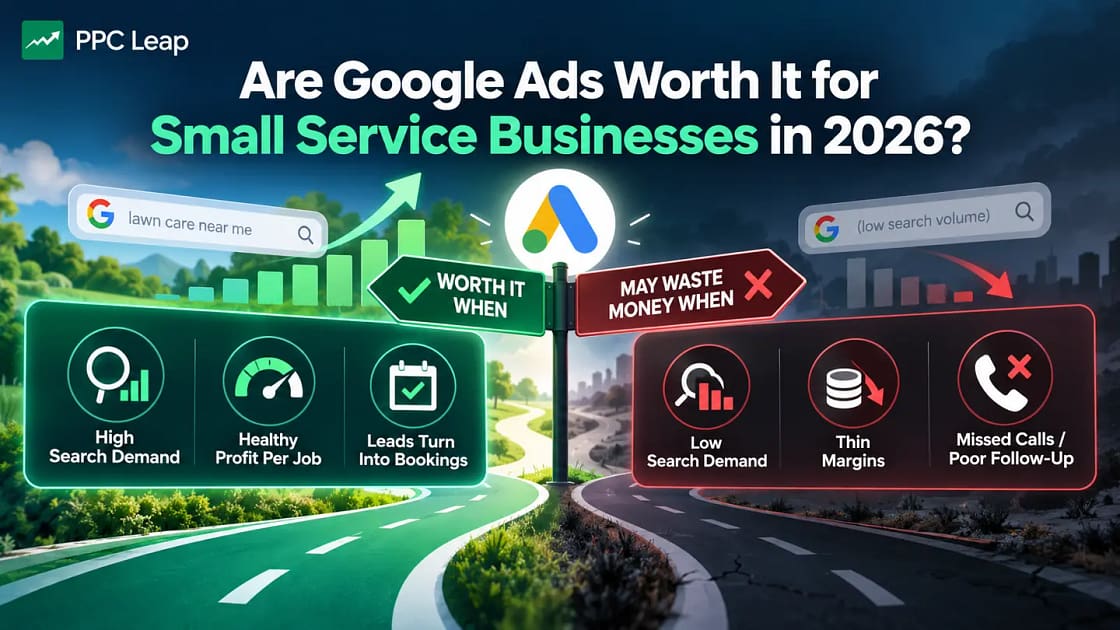
Yes, Google Ads can be worth it for small service businesses in 2026, but not for everyone. They work best when customers actively search for your services, each job earns enough profit to cover advertising costs, and your business can turn inquiries into bookings. Google Ads may waste money if your services have little search demand, your profit margins are too low, or your team misses customer calls. Before investing, compare your expected cost per customer with your profit per job. This guide explains when Google Ads work, when they don’t, and how to make that decision for your business.
Do Google Ads Really Work for Small Businesses?
Google Ads can help small businesses reach people who are already looking for their services.
For example, someone searching for “emergency plumber near me” is likely trying to find a plumber who can solve an immediate problem.
A plumbing company can use Google Search Ads to appear in relevant sponsored search results and connect with that potential customer.
This is different from advertising to people who may not need the service right now.
However, appearing in search results does not guarantee phone calls, bookings, or profit.
A successful campaign needs more than clicks. Your advertising must reach suitable customers, your website must help them contact you, and your business must be able to close the sale.
Here is a simple way to judge whether Google Ads may be suitable:
| Google Ads May Be Worth It When | Google Ads May Not Be Worth It When |
| Customers actively search for your services | Few people search for your services |
| Jobs generate enough profit to cover advertising | Profit per job is too low |
| You serve a clear geographic area | Your target area has very little search demand |
| Your website generates calls or quote requests | Visitors leave without contacting you |
| Someone responds to customer inquiries | Calls and messages regularly go unanswered |
| You have room to accept more bookings | Your team cannot handle additional jobs |
If your business meets most of the conditions in the first column, Google Ads may be worth testing.
The next step is understanding what makes paid advertising useful for local service businesses.
When Are Google Ads Worth It for Local Service Businesses?
Google Ads can be especially useful when people already know what service they need and are looking for a company to hire.
Several situations make paid search a stronger option.
1. Customers Need Your Service Immediately
Urgent service searches often show clear buying intent.
For example, someone with a burst pipe may search for an emergency plumber. A driver with a flat tyre may look for mobile tyre fitting nearby.
These people are not simply learning about a topic. They need a service provider.
Google Search Ads can help businesses appear for relevant searches while customers are looking for help.
This can benefit plumbers, electricians, towing companies, locksmiths, and other businesses that handle urgent problems.
However, emergency search terms can attract strong competition. You still need to check whether the jobs are valuable enough to cover the advertising costs.
2. Your Services Generate Enough Profit Per Job
A higher-value job can make paid advertising easier to afford.
For example, a roofing company winning a large roof replacement may earn enough contribution from one completed project to cover several customer inquiries.
A business offering a low-priced, one-time service may have less money available for advertising.
The key difference is not just the total price charged to the customer.
It is how much money remains after paying the direct costs of completing the job.
A $5,000 project with high labour and material costs may leave less profit than a smaller project with better margins.
Google Ads become more attractive when the profit from completed jobs can comfortably cover the cost of winning new customers.
3. You Want Customers From Specific Locations
Local service businesses usually operate within defined service areas.
A pest control company may only serve certain suburbs. A cleaning company may work within a particular city.
Google Ads allows advertisers to target locations and exclude areas they do not serve.
This helps businesses focus their advertising on customers who are more likely to book their services.
However, location targeting is not perfectly accurate. Google’s default settings can also include people who show interest in a location, even when they are outside it.
Businesses should review their location settings and campaign reports to avoid spending money on unsuitable areas.
4. You Need More Bookings During Certain Periods
Some local services experience changing demand throughout the year.
For example, air conditioning repairs may receive more searches during hot weather. Roofing companies may experience higher demand after severe storms.
Google Ads gives businesses control over campaign budgets and when advertising runs.
This makes it possible to increase visibility when additional bookings are needed and reduce spending when demand or available capacity changes.
However, increasing a budget does not guarantee more customers. There must still be enough suitable searches available.
The flexibility is useful when your business knows which services it wants to promote and can handle the resulting inquiries.
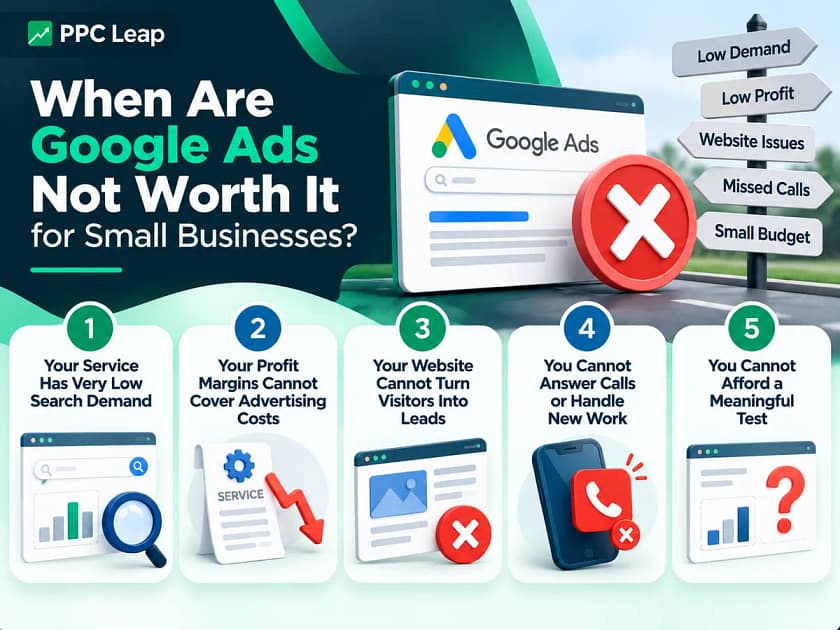
When Are Google Ads Not Worth It for Small Businesses?
Google Ads are not automatically the right choice for every local service business.
In some situations, even a well-managed campaign may struggle to produce profitable customers.
Here are five important warning signs.
Your Service Has Very Low Search Demand
Google Search Ads mainly help businesses reach people who are already searching for something.
If very few people search for your service, paid search has limited demand to capture.
For example, a company introducing an unfamiliar service may struggle because potential customers do not yet know what to search for.
This does not mean the service has no market.
It means Google Search may not be the best place to introduce it.
Before launching ads, check the main service keywords and related searches in Google Keyword Planner.
Focus on your actual service area rather than national search volume.
If local demand is extremely limited, consider building awareness through other marketing channels before investing heavily in Search Ads.
Your Profit Margins Cannot Cover Advertising Costs
A campaign can generate genuine leads and still lose money.
Suppose a small service business earns $80 from a job after paying direct service costs.
If it spends $150 on advertising to win that customer, it loses $70 before accounting for other business expenses.
More bookings would only create more losses at the same acquisition cost.
This is why businesses should calculate their available profit before deciding to advertise.
A low-cost service may still support Google Ads if customers book regularly, buy additional services, or generate enough long-term profit.
However, those extra earnings should be based on real customer records rather than assumptions.
If your expected advertising cost is consistently higher than the profit available, Google Ads may not be suitable for that service.
Your Website Cannot Turn Visitors Into Leads
Getting someone to click your ad is only the first step.
After clicking, the visitor needs a clear reason to contact your business.
Imagine someone searches for commercial office cleaning but arrives on a homepage that does not explain commercial cleaning services.
They may leave and choose another company.
Common website problems include confusing service information, slow loading, poor mobile design, and contact details that are difficult to find.
A useful landing page should clearly explain the service, show relevant trust information, and make requesting a quote simple.
If your existing website struggles to generate inquiries, improving it may be more valuable than immediately increasing ad spend.
PPC Leap offers landing page design for Google Ads campaigns to help local businesses create a clearer path from paid clicks to customer inquiries.
You Cannot Answer Calls or Handle New Work
Google Ads cannot turn an unanswered phone call into a completed job.
Suppose a pest control company receives 20 inquiries from advertising.
If the team misses eight calls and never follows up, those potential customers may contact another company.
The business has already paid for the traffic that generated those inquiries.
This becomes even more important for urgent services, where customers may contact several providers.
Before advertising, decide who will answer calls, reply to messages, and provide quotes.
Your team should also have enough availability to complete additional jobs.
If you cannot handle more work, increasing advertising spend may create unnecessary costs.
You Cannot Afford a Meaningful Test
Google does not set a universal minimum advertising budget.
However, some services have expensive clicks and need enough spending to gather useful results.
Imagine your estimated cost per lead is $100.
A $300 campaign might generate only three leads at that rate.
If none becomes a customer, you may not have enough information to know whether the problem was your advertisement, the inquiries, or the sales process.
A campaign also needs regular monitoring and adjustments.
If your business cannot afford a reasonable testing period without affecting normal expenses, it may be better to delay paid advertising.
The right test budget depends on your local advertising costs and how much data you need to evaluate performance.
How to Know If Google Ads Will Be Profitable for Your Business
The most important question is not how many clicks your ads generate.
It is how much you spend to win one paying customer compared with the profit that customer brings.
To calculate this, you need to understand three numbers.
Cost per lead (CPL) is the advertising cost of generating an inquiry.
Closing rate is the percentage of leads that become paying customers.
Customer acquisition cost (CAC) is the total cost of winning a customer.
For a simple Google Ads calculation:
Ad Cost Per Customer = Cost Per Lead ÷ Closing Rate
Your total customer acquisition cost should also include related expenses, such as management fees.
Example: When Google Ads Are Worth It
Imagine a local cleaning company with the following numbers:
| Business Metric | Amount |
| Average job revenue | $850 |
| Direct labour, materials and job costs | $450 |
| Contribution before marketing and overhead | $400 |
| Google Ads cost per lead | $75 |
| Lead-to-customer closing rate | 40% |
| Advertising cost per booked customer | $187.50 |
| Allocated management cost per customer | $35 |
| Total customer acquisition cost | $222.50 |
The business earns $400 per completed job before marketing expenses and fixed overhead.
It spends $222.50 to acquire each customer.
That leaves $177.50 per job before fixed overhead and taxes.
Whether that amount is acceptable depends on the company’s remaining expenses and profit goals.
Under these assumptions, Google Ads could be worth continuing if the jobs produce an adequate final profit.
Example: When the Same Google Ads Campaign Loses Money
Now suppose the company receives the same leads at the same cost, but its closing rate drops from 40% to 20%.
Its advertising cost per customer becomes:
$75 ÷ 0.20 = $375
Add the same $35 management allocation.
The total customer acquisition cost is now $410.
| Metric | At 40% Closing Rate | At 20% Closing Rate |
| Cost per lead | $75 | $75 |
| Advertising cost per customer | $187.50 | $375 |
| Management cost per customer | $35 | $35 |
| Total acquisition cost | $222.50 | $410 |
| Amount remaining from $400 contribution | $177.50 | -$10 |
The campaign generates leads at the same price in both examples.
But the business loses money in the second scenario before paying fixed overhead and taxes.
This is why Google Ads results depend on more than campaign performance.
Your ability to answer inquiries, provide quotes, and win jobs directly affects whether the advertising is profitable.
All figures in these two examples are illustrative, not reported results from an actual PPC Leap client.
What Do Google Ads Cost for Small Businesses in 2026?
Advertising costs vary widely between industries.
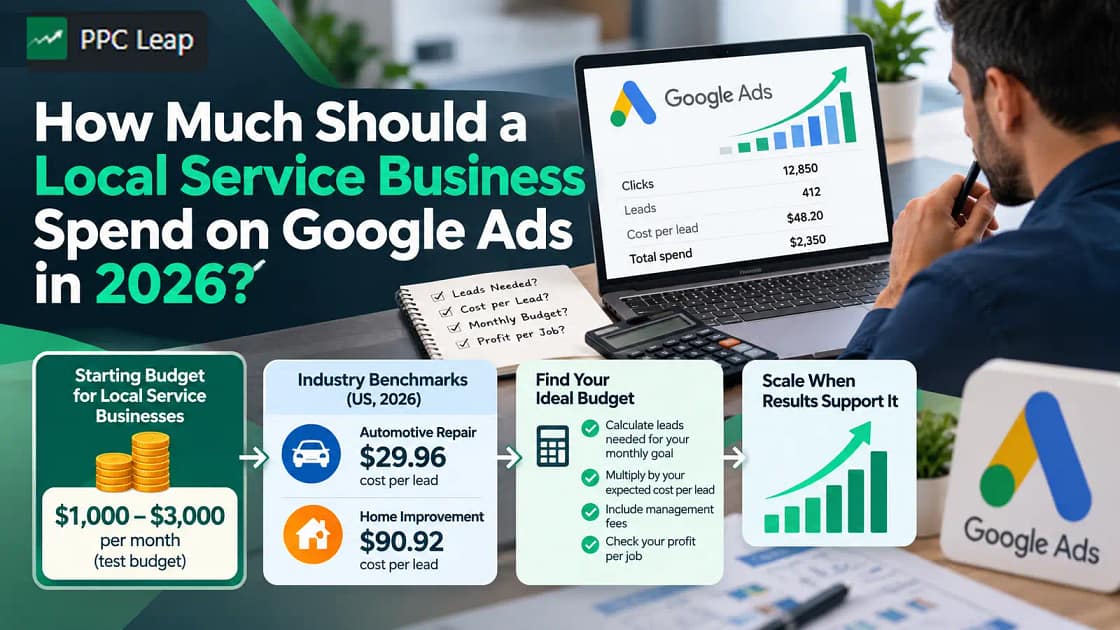
According to WordStream and LocaliQ’s 2026 search advertising benchmarks, the median cost per lead across the studied US industries was $66.69.
The study examined 13,474 US-based search advertising campaigns running between April 2025 and March 2026.
It included both Google Ads and Microsoft Ads campaigns, so the figures are broader search advertising benchmarks rather than Google-only prices.
Here are several relevant categories:
| Industry Category | Median Cost Per Lead |
| Automotive Repair, Service & Parts | $29.96 |
| Personal Services | $54.60 |
| Industrial & Commercial | $75.19 |
| Home & Home Improvement | $90.92 |
| Business Services | $93.69 |
Source: WordStream and LocaliQ, 2026 Search Advertising Benchmarks. Figures are in USD.
The difference matters.
A local automotive repair business may face very different lead costs from a roofing or home improvement company.
However, these are broad industry categories. They should not be treated as exact costs for plumbers, cleaners, electricians, or pest control businesses.
Your own cost will depend on your location, keywords, competition, landing page, and campaign setup.
Industry benchmarks can help you estimate whether advertising is affordable, but your actual customer acquisition cost should guide the final decision.
Are Google Ads Worth It for Contractors and Home Service Businesses?
Google Ads can work for contractors, but the results depend on the type of work they want to attract.
Some services receive urgent searches. Others involve larger projects where customers compare several companies before choosing one.
The table below shows how different businesses should approach the decision.
| Local Service Business | Where Google Ads May Help | What to Watch |
| Plumbing | Emergency repairs and local plumbing services | High competition for urgent searches |
| Pest Control | Pest removal and treatment inquiries | Seasonal demand and lead quality |
| Roofing | Roof repairs, inspections and replacements | High lead costs and longer sales cycles |
| Cleaning | Commercial contracts and residential bookings | Profit per job and repeat business |
| Towing | Urgent roadside and vehicle recovery searches | Location accuracy and call response |
| Electrical | Repairs, installations and urgent electrical work | Keyword competition and job value |
| Moving | Local moving quotes and relocation services | Quote comparisons and booking rates |
| Pressure Washing | Driveway, exterior and commercial cleaning | Smaller job values and local demand |
These are possible use cases, not guaranteed profitable industries.
For example, a roofing company may be able to pay more for a qualified replacement inquiry than a cleaning company can afford for a small one-time job.
However, a cleaning company winning regular commercial contracts may earn significant value from repeat work.
The important question is whether your specific service, customer value, and closing rate can support the cost of paid advertising.
A business should evaluate individual services rather than assuming Google Ads will work equally well across everything it offers.
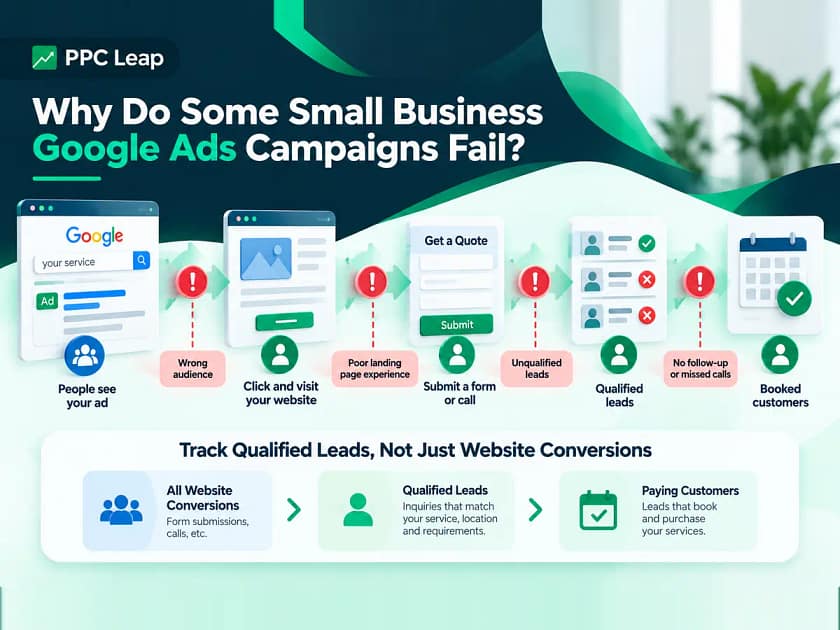
Why Do Some Small Business Google Ads Campaigns Fail?
A failed campaign does not always mean Google Ads is unsuitable for the business.
Sometimes the business has enough demand and profit potential, but the campaign sends traffic to the wrong place or attracts the wrong people.
The first step is finding where the process stops working.
| Problem | Possible Cause | What to Check |
| Ads receive impressions but few clicks | Weak ad relevance or unsuitable searches | Keywords, ad messages and search intent |
| Clicks increase but inquiries remain low | Landing page or targeting problems | Page content, mobile experience and contact options |
| Many inquiries are irrelevant | Ads attract the wrong searches | Search terms, negative keywords and locations |
| Genuine leads rarely book | Problems after the inquiry | Missed calls, quote process and follow-up |
| Customers book but advertising loses money | Acquisition costs exceed available profit | Job margins, closing rate and total marketing costs |
These problems require different solutions.
Changing ad copy will not fix a team that never answers the phone.
Increasing the daily budget will not improve a service with weak profit margins.
And rebuilding the website may not solve a campaign that targets people looking for unrelated services.
Before spending more, identify which part of the customer journey needs attention.
Track Qualified Leads, Not Just Website Conversions
Google Ads can count form submissions and other tracked actions as conversions.
However, a conversion is not always a qualified lead.
A qualified lead is someone whose inquiry fits your service, location, and business requirements.
A paying customer is someone who goes further and books or purchases the service.
Keeping these stages separate helps businesses identify their real advertising results.
For example, a campaign producing 50 inquiries may look successful.
But if only five inquiries match your services and just one becomes a customer, the reported cost per conversion may hide the actual cost of winning work.
Google Ads supports tracking qualified and converted leads through its lead measurement tools.
Connecting advertising results with CRM records and booked jobs provides a more useful picture of performance.
How to Test Whether Google Ads Are Worth It Before Spending More
If your business appears suitable for paid advertising, begin with a controlled test rather than spreading money across many services.
The aim is to gather enough information to decide whether Google Ads can attract profitable customers.
Step 1: Check Local Search Demand and Profitability
Start by identifying the service you want to promote.
Use Google Keyword Planner to estimate how often people search for related services in your target locations.
Review estimated advertising costs and calculate how much you can afford to spend to win a customer.
If the numbers do not support a profitable result, reconsider the service or advertising approach before launching.
Step 2: Build a Focused Search Campaign
Choose a small group of relevant service keywords and target areas where your business can operate.
Make sure your advertisements match the service being offered.
Review location settings carefully, especially if customers must be physically within your service area.
Add suitable negative keywords to reduce irrelevant searches.
Set up conversion tracking before the campaign launches, and test that it records inquiries correctly.
Step 3: Run the Campaign and Review Lead Quality
A new campaign may begin generating clicks quickly, but meaningful evaluation can take longer.
Use the first few weeks to check whether the ads attract suitable searches, whether tracking works, and whether people contact your business.
For a new small-business campaign, a planned test of approximately 60–90 days can be a useful approach when the budget allows.
This is an editorial planning recommendation, not a mandatory Google Ads learning period.
Some campaigns need more time because lead volume is low or customers take longer to book.
Avoid judging the entire campaign from a few clicks or one slow week.
Step 4: Compare Results With Your Customer Acquisition Target
Once you have enough reliable data, review how much each paying customer costs.
Compare that amount with the contribution from completed jobs.
You may find that the campaign needs better targeting, stronger landing pages, or improved sales follow-up.
If customer acquisition is profitable and your business can handle more work, you can consider increasing the budget.
If the results remain unprofitable after identifying and addressing realistic problems, reducing or stopping the campaign may be the better decision.
The purpose of the test is to find an answer for your business, not to prove that Google Ads must work.
How PPC Leap Improved Lead Relevance for a Canadian Business
PPC Leap has published a Google Ads case study involving a junk car buying business operating in Canada.
The company wanted inquiries from people interested in selling unwanted vehicles.
However, its existing advertising was also attracting people searching for car parts, scrap metal, and repair services.
These searches were not relevant to the company’s main business.
The problem was not simply a lack of traffic.
The campaign was spending money on inquiries that did not match the service.
What PPC Leap Changed
PPC Leap rebuilt the campaign around searches connected with selling unwanted vehicles.
The work included refining the keyword strategy, excluding unrelated searches, and improving conversion tracking.
The campaign also began tracking phone calls, form submissions, and WhatsApp interactions.
According to PPC Leap’s Canadian junk car buyer case study, the campaign recorded the following results between January 18 and February 11, 2026.
| Reported Campaign Metric | Result |
| Total advertising spend | CA$2,807.65 |
| Phone calls | 158 |
| Cost per phone call | CA$17.77 |
| Tracked contact channels | Calls, forms and WhatsApp |
| Campaign type | Google Search |
These figures come from one reported campaign and should not be treated as average results for other businesses.
The published case study does not provide a verified final number of paying customers or net profit, so the figures alone cannot establish the campaign’s financial return.
However, the example shows an important difference between generating traffic and attracting suitable inquiries.
A business can spend money on Google Ads and receive calls, yet still struggle if those callers want something it does not offer.
Relevant searches, accurate tracking, and genuine customer interest matter more than lead volume alone.
Google Ads vs SEO – Which Is Better for a Small Service Business?
Google Ads is not the only way for local businesses to attract customers.
Local SEO, Google Business Profile, referrals, and other marketing channels can also help generate inquiries.
The best option depends on your goals, available budget, and how customers discover your services.
| Marketing Channel | Main Advantage | Main Limitation |
| Google Search Ads | Can reach people actively searching for services | Traffic depends on ongoing advertising spend |
| Local SEO | Builds visibility in unpaid local search results | Rankings and traffic take time and are not guaranteed |
| Google Business Profile | Helps customers find business details in Google Search and Maps | Visibility depends on relevance, distance and prominence |
| Referrals | Can bring customers who already have some trust | Lead volume may be unpredictable |
| Paid Social Advertising | Can reach people before they actively search | People may not need the service immediately |
Google Search Ads are often useful when a business needs visibility for existing customer demand.
Local SEO can support longer-term discovery through relevant service pages, useful content, and local search visibility.
Google Business Profile also matters for eligible local companies because customers often compare nearby businesses, reviews, and contact details.
A business with limited funds may need to focus on one channel first.
For example, a company with little search demand may benefit more from building awareness and referrals.
A business with strong search demand and profitable jobs may find paid search worth testing.
Many established service companies can benefit from combining paid advertising with organic search, rather than treating the two as permanent alternatives.
Five Questions to Ask Before Investing in Google Ads
Before committing to a campaign, answer these questions about your business.
| Question | What You Need to Know |
| Are customers searching for my services? | Check local demand for relevant service keywords. |
| How much can I afford to pay for a new customer? | Calculate available profit after direct job costs and other expenses. |
| Can my website turn visitors into inquiries? | Check service relevance, contact options and mobile experience. |
| Can my team respond to leads and accept more jobs? | Review call handling, quoting and available capacity. |
| Can I measure the results? | Track qualified inquiries, completed bookings and acquisition costs. |
If you cannot answer several of these questions, it may be too early to commit a large advertising budget.
That does not mean Google Ads will never work for your business.
It means you should check or improve a few key things before paying for more traffic.

Frequently Asked Questions
1. Are Google Ads Worth It for Contractors in 2026?
Google Ads can be worth it for contractors offering services with clear search demand and enough profit per job. Plumbing, roofing, electrical, and other trades should compare local lead costs with their actual booking rates before investing.
2. Can Google Ads Work for a Small Business With No Reviews?
Yes, but limited reviews may make it harder to earn customer trust. A clear service page, accurate business information, relevant experience, and simple contact options can help while the business builds genuine customer feedback.
3. Why Am I Getting Google Ads Clicks but No Customers?
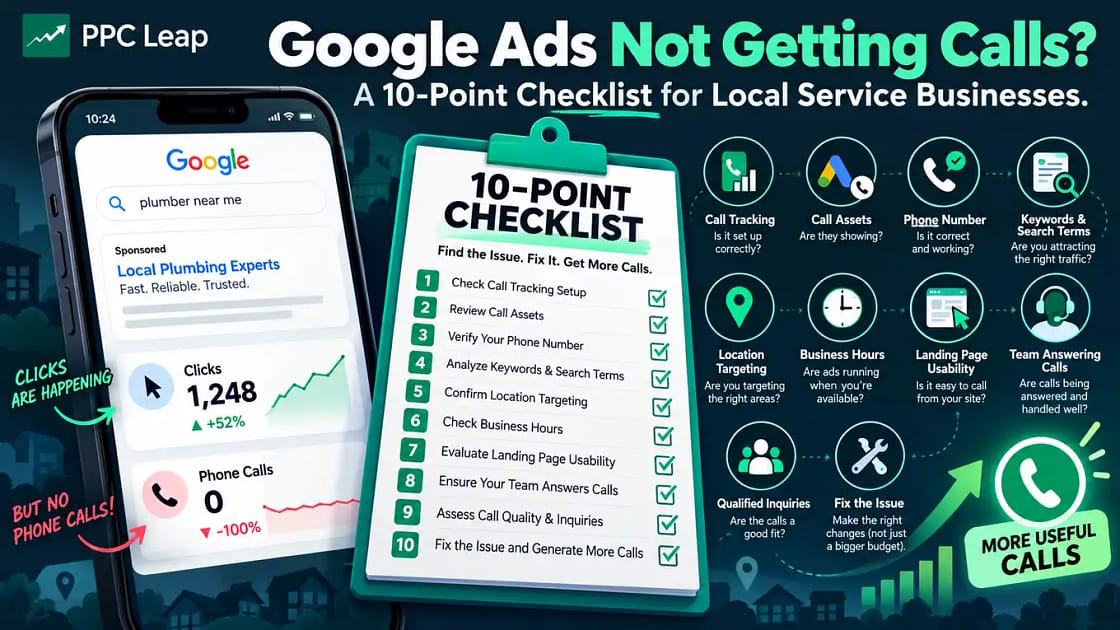
Clicks without customers may result from unsuitable keywords, weak landing pages, missed calls, or poor sales follow-up. Check search terms and real customer inquiries first, then identify whether the problem occurs before or after someone contacts you.
4. Are Google Ads Worth It if My Business Already Ranks on Google Maps?
They may be, especially for services or locations where your business needs more visibility. However, paid ads can sometimes attract customers you might have received organically. Compare total bookings and acquisition costs before increasing advertising.
5. Should I Stop Google Ads if My First Month Is Not Profitable?
Not necessarily. One month may provide too little data, particularly for services with longer sales cycles. Check tracking accuracy, lead quality, and customer acquisition costs. Continue only if the remaining test budget is affordable and improvements appear realistic.
Final Verdict
Google Ads can be a valuable customer acquisition channel for local service businesses, but they are worth the investment only when the cost of winning customers fits the business’s financial goals.
They are most suitable when people actively search for your services, your jobs generate enough profit, and your team can respond to inquiries and complete additional work.
They may not be the right choice when local search demand is weak, profit margins are too small, or the business cannot convert inquiries into paying customers.
Before investing, check your local market, calculate an affordable customer acquisition cost, and prepare your website and lead-handling process.
If you decide to advertise, start with a focused campaign, measure qualified leads and booked jobs, and use the results to decide whether to improve, expand, or stop.
Not sure whether Google Ads are right for your business? PPC Leap offers Google Ads management and account analysis to help local service businesses review their campaigns, identify wasted spending, and make informed advertising decisions. Book a free account analysis to discuss your business goals.