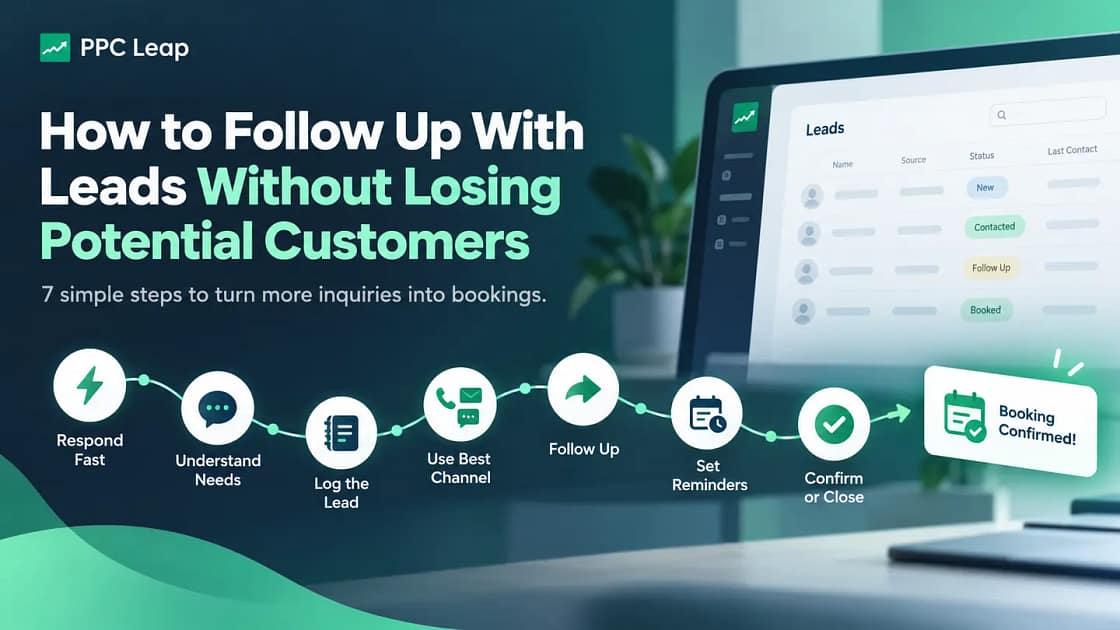
To follow up with leads without losing potential customers, respond quickly, understand their needs, and give them a clear next step. Record every inquiry in a CRM or lead tracker, contact customers through their preferred channel, and follow up on unanswered quotes. Use phone calls, emails, or SMS when appropriate, and set reminders so you don’t forget any inquiry. Automation can help with routine tasks, but every message should be useful. Stop follow-ups when someone books, declines, or asks you to stop. These seven steps will help local service businesses turn more inquiries into confirmed bookings.
Why Do Local Businesses Lose Leads After the First Inquiry?
Local businesses spend money on Google Ads, SEO, and other marketing channels to attract customers. However, receiving an inquiry does not guarantee a booking.
Imagine a homeowner searching for an emergency plumber. They contact three companies. One answers immediately, another replies hours later, and the third never responds.
The homeowner may book with the first available company.
Similar problems happen when businesses miss calls, forget to follow up on quotes, or leave inquiries unanswered in different inboxes.
Common reasons leads are lost include slow replies, poor communication, missing customer details, and unclear follow-up responsibilities.
A proper lead management process can help prevent these problems.
For businesses handling frequent calls and messages, AI solutions for local businesses can also support inquiry handling, reminders, and customer communication.
The key is to make sure every potential customer receives a useful response and knows what happens next.
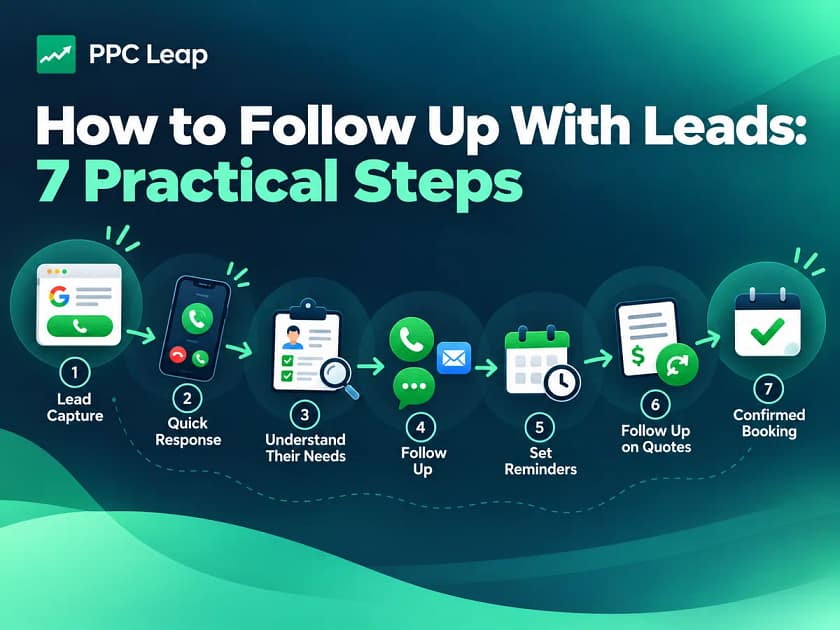
How to Follow Up With Leads – 7 Practical Steps
You do not need a large sales team to manage leads properly.
A simple process can help your business respond to inquiries, track customer needs, and arrange more bookings.
1. Capture Every Lead in One Place
The first step is to record every customer inquiry.
Leads may come through phone calls, website forms, emails, WhatsApp, or social media messages.
When customer information stays in separate places, employees can forget who needs a response.
Use a CRM or shared lead tracker to keep the necessary details together.
For example:
| Lead Information | Example |
| Customer name | Sarah |
| Requested service | End of lease cleaning |
| Location | Brisbane |
| Contact method | Website form |
| Lead status | New |
| Assigned staff | Office manager |
| Next action | Call to discuss the quote |
Only collect the information needed to handle the request.
Assign each new lead to a specific person. This prevents employees from assuming someone else will respond.
Every active lead should have an owner and a clear next action.
2. Respond to New Leads Quickly
Customers often contact several businesses when they need a service.
If your team takes too long to reply, the customer may choose another provider.
For urgent services, such as towing or emergency plumbing, a fast response is especially important.
For planned services, such as commercial cleaning or landscaping, customers may have more time to decide.
A five-minute response target during staffed hours can be useful for high-intent inquiries when your team can manage it.
However, this is a practical goal, not a guarantee of more bookings.
If you cannot provide an answer immediately, send a short acknowledgement.
Example:
“Hi Sarah, thanks for contacting ABC Cleaning. We received your request for end-of-lease cleaning. Our team will review the details and contact you during business hours.”
Only promise a response time your business can meet.
An acknowledgement lets the customer know their message arrived, but someone still needs to handle the request.
3. Understand What the Customer Needs
Not every customer is ready to book immediately.
Some need urgent help. Others want a quote or plan to hire someone later.
Ask a few relevant questions before deciding how to follow up.
For example, a cleaning company may need to know the property size, suburb, cleaning type, and preferred date.
A roofing contractor may need to know whether the customer wants a repair, inspection, or replacement.
Use the answers to decide the next step.
| Lead Type | Customer Need | Next Action |
| Urgent | Immediate service | Prioritise contact |
| Ready to book | Wants an appointment | Offer available dates |
| Quote request | Needs pricing | Prepare an estimate |
| Future project | Planning ahead | Record an agreed follow-up date |
| Unsuitable | Needs an unavailable service | Explain and close the inquiry |
This helps your team focus on customers who need attention without pressuring people who are not ready.
4. Use the Right Follow-Up Channel
Phone calls, emails, SMS, and WhatsApp can all help businesses stay in contact with potential customers.
However, the best channel depends on the customer’s request and communication preferences.
Phone calls work well for urgent services or inquiries that need discussion.
Emails are useful for quotes, service details, and written information.
SMS messages can help arrange callbacks, confirm appointments, or send short updates.
WhatsApp and social messages may be suitable when customers have contacted your business through those channels.
For example, a roofing customer who requested a written estimate may prefer email instead of repeated phone calls.
Avoid contacting every lead through multiple channels without a clear reason.
Use permitted communication methods and respect the customer’s preferences.
5. Follow Up After Sending a Quote
Sending a quote does not mean the customer has made a decision.
They may need time to compare services, discuss the price, or confirm a suitable date.
A follow-up can help answer questions and move the conversation forward.
For example:
“Hi Emma, this is ABC Roofing. I wanted to confirm you received our estimate. If you have any questions about the repair work or materials, I’d be happy to help.”
For many planned services, following up within one or two business days can be a reasonable starting point.
However, if the customer has already agreed on a specific date, follow that arrangement.
Avoid sending repeated reminders or creating false urgency.
A good quote follow-up helps the customer make a decision rather than pressuring them to book.
6. Create a Simple Lead Follow-Up Schedule
A clear schedule helps your team contact customers consistently.
Without one, some leads may receive several calls while others are forgotten.
Here is an example of a seven-day follow-up sequence for a non-urgent service inquiry.
| Timing | Suggested Action | Purpose |
| Day 0 | Respond to the inquiry | Confirm the request |
| Day 1 | Follow up if needed | Answer questions |
| Day 3 | Send a useful reminder | Discuss the quote or appointment |
| Day 5 | Check whether help is still needed | Confirm customer interest |
| Day 7 | Send a polite final follow-up | Close the active request |
This is an example, not a fixed schedule for every customer.
An emergency request may need an immediate response, while a commercial project may require a longer decision period.
If someone replies, books, declines, or asks you to stop, update the schedule.
Do not continue sending messages simply because a reminder was previously created.
7. Track Every Next Step and Know When to Stop
A follow-up process should show what happens after each customer interaction.
For example, if someone agrees to a callback tomorrow, record that date.
If a customer accepts a quote, update their status to booked.
A simple sales pipeline can help:
| Lead Status | Meaning |
| New | Inquiry received |
| Contacted | First response completed |
| Qualified | Request matches your services |
| Quoted | Estimate sent |
| Follow-Up Due | Next contact is scheduled |
| Booked | Customer accepted the service |
| Closed | Request ended or customer declined |
Every active lead should have a next action.
When a customer books, declines, or opts out, stop unnecessary sales reminders.
This keeps your communication relevant and prevents customers from receiving messages that no longer match their situation.
What Should You Say When Following Up With Leads?
A useful follow-up message should be short, clear, and related to the customer’s request.
Avoid generic sales pitches or repeating the same reminder.
Here are three examples local service businesses can adapt.
After a Missed Call
“Hi James, this is ABC Plumbing. Sorry we missed your call. If you still need assistance, let us know a suitable callback time during our office hours.”
After Sending an Estimate
“Hi Emma, just checking whether you received our cleaning quote. If you have questions about the services or available dates, we’d be happy to help.”
Final Follow-Up
“Hi Daniel, we haven’t heard back about your moving quote, so we’ll close the current request for now. You’re welcome to contact us if you need help later.”
Each message serves a different purpose.
Use these examples only when the communication is appropriate and permitted.

How Can CRM and AI Automation Improve Lead Follow-Up?
As a local business grows, managing every inquiry manually can become difficult.
Customer information may be spread across emails, phone records, and messaging apps.
A CRM helps bring those records together.
It can show which leads are new, which customers are waiting for quotes, and which follow-ups are due.
Automation can then handle selected repetitive tasks.
Example of an Automated Follow-Up Workflow
When someone submits a website form, an automation could:
- Create a new lead record in the CRM.
- Assign the inquiry to a staff member.
- Send an approved acknowledgement when permitted.
- Create a reminder if the inquiry remains unanswered.
- Stop or update reminders when the customer books or declines.
This reduces manual work and helps staff see what needs attention.
PPC Leap’s AI automation services can help local businesses explore connected workflows for lead tracking, customer communication, and routine tasks.
AI can also help organise inquiries or identify missing service details.
For example, it may identify that a customer needs carpet cleaning and ask for the property location.
However, it should not promise prices or appointment times without approved information.
Unusual requests should be passed to a person.
Automation should support customer service, not replace necessary human decisions.
Common Lead Follow-Up Mistakes to Avoid
Even a simple follow-up system can fail if responsibilities are unclear.
These are common mistakes:
| Mistake | Better Approach |
| Waiting too long to reply | Set a realistic response target |
| Forgetting pending quotes | Schedule the next follow-up |
| Sending generic messages | Refer to the customer’s request |
| Contacting customers repeatedly | Use a suitable schedule |
| Leaving leads unassigned | Give each lead an owner |
| Continuing after an opt-out | Stop the relevant messages |
| Tracking replies but not bookings | Record final customer outcomes |
Avoid treating every inquiry the same way.
A homeowner requesting emergency repairs needs a different response from a company planning a cleaning contract for next month.
Focus on useful conversations rather than sending more messages.

How Do You Measure Lead Follow-Up Success?
The goal of following up is not simply to increase the number of calls or emails sent.
You need to know whether your process helps turn suitable inquiries into booked customers.
Three useful metrics are:
First response time: How long your team takes to reply to a new inquiry.
Contact rate: The percentage of leads your team reaches for a meaningful conversation.
Booking rate: The percentage of inquiries that become confirmed bookings.
Example: Calculating Your Lead Booking Rate
Imagine a local cleaning company receives 50 inquiries in one month.
Its team reaches 40 leads, and 12 become confirmed bookings.
| Metric | Result |
| Total inquiries | 50 |
| Leads contacted | 40 |
| Confirmed bookings | 12 |
| Contact rate | 80% |
| Booking rate | 24% |
Booking Rate = (Confirmed Bookings ÷ Total Leads) × 100
12 ÷ 50 × 100 = 24%
These are illustrative figures.
The business can review why 10 leads were not reached and what prevented other inquiries from becoming bookings.
This becomes especially important when leads come from paid advertising.
For example, Google Ads management should not focus only on generating clicks and form submissions. Connecting campaign data with qualified inquiries and actual bookings helps businesses judge whether their advertising produces valuable customers.
Follow Up Without Sending Unwanted Messages
Lead follow-up should respect customer preferences and applicable communication rules.
Requirements for marketing emails, SMS, and automated calls vary between countries, including the US, UK, Canada, Australia, and New Zealand.
A customer requesting a quote has not necessarily agreed to receive unrelated promotional messages.
Use the appropriate permissions for each communication method.
Identify your business clearly and respect requests to stop receiving messages.
If you use automation, make sure opt-outs and completed bookings update the relevant workflows.
This helps keep customer communication useful and avoids unnecessary contact.
Frequently Asked Questions
1. How Many Times Should You Follow Up With a Lead?
There is no fixed number for every business. Three to five useful follow-ups may be a starting point for some inquiries. Adjust the schedule to customer needs and permissions, and stop when the customer books, declines, or opts out.
2. How Quickly Should You Follow Up With a New Lead?
Respond as soon as reasonably possible during staffed hours. For urgent inquiries, a five-minute response target may be useful when practical. Planned services may allow more time, but customers should receive a clear next step.
3. What Should You Say When a Lead Doesn’t Respond?
Refer to the customer’s original request and offer one helpful next step. You could ask whether they received the quote or need help arranging an appointment. Keep the message short and avoid repeated generic reminders.
4. Can AI Automatically Follow Up With Leads?
Yes. AI and automation can help acknowledge inquiries, create CRM tasks, send permitted reminders, and organise lead information. However, workflows need clear rules, customer permissions, stopping conditions, and human support for requests they cannot handle safely.
5. How Do You Follow Up With Old Leads?
Review the original inquiry, customer preferences, and whether further contact is permitted. If appropriate, send a relevant message about the service they requested. Do not add inactive leads to promotional campaigns without the required permission.
How to Follow Up With Leads Without Losing Customers
Effective lead follow-up starts with a simple process: record every inquiry, respond quickly, understand customer needs, and provide a clear next step.
Use a suitable communication channel, follow up on pending quotes, and keep customer information organised.
A CRM can help track leads, while AI automation can handle routine acknowledgements, reminders, and task assignments.
Stop unnecessary messages when customers book, decline, or ask not to be contacted.
Most importantly, measure success through qualified leads and confirmed bookings rather than the number of messages sent.
Need help improving your lead follow-up process? PPC Leap helps local service businesses explore AI and automation workflows that can reduce repetitive work and support customer communication.
Book a free growth call to discuss your business’s lead management needs.